
- News
- City News
- hubballi News
- Expert reveals how and why Neerasagar dries up frequently
Trending
This story is from May 11, 2019
Expert reveals how and why Neerasagar dries up frequently
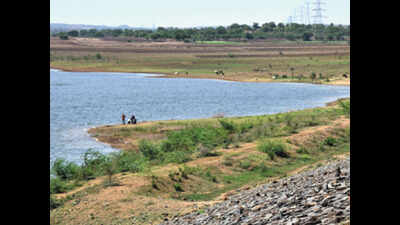
Neerasagar Lake, once the prime source of drinking water for Dharwad, has almost dried up
The lake has been drying up frequently and is almost completely dry causing a shortage of drinking water in parts of Hubballi.

Professor Vinayakrao K Deshpande, who had presented a paper at International symposium on Tropical Ecology at Varanasi in 1988, traces the reasons for the lake going dry frequently. He says it is the impact of urban development on fresh water resources.
Professor Deshpande said three main streams, Bedti Halla, Attikolla Halla and Shalmala Halla feed Neerasagar reservoir. “A Bombay State gazetteer compiled by Venkat Rango Katti in 1884 clearly shows a map of these three streams forming the Shalmala River, which is now said to flow underground up to Mishrikoti, where Karkihalla from Hubballi joins it,” he says.
“Extensive deforestation on the hill ranges in this area resulted in soil erosion over hundreds of years and silted the stream beds, thus preventing smooth flow of rain water. That is the reason for Shalmala going underground,” he adds.
“Irrigation tanks have been built along the course of these streams and the stream beds are converted into paddy lands downstream. Excess water is let out into a narrow channel, further joining other tanks like Mangundi. Jammihal and Dhumwad tanks and paddy lands submerged in Neersagar, built in 1957,” he says.
The professor recalled that water from the lake was supplied to Dharwad only for two three hours every day in the morning for the next 25 years.
“Now rainwater is trapped by small bunds to feed the brick kilns along Attikolla Halla before it joins Managundi tank. Abandoned stone quarries around Mugad and Mansur trap rainwater flowing towards Bedti Halla which originates from Mugad tank. After the construction of NH4 bypass in 1992, rain water is not flowing beyond Mansur. Urban development, extensions and layouts on the hills are also blocking storm water drainage towards Neerasagar,” he says.
Now, only Bedti Halla is feeding water into Neerasagar when there is sufficient rainfall in that area,” Prof Deshpande observes.
“If at all Neerasagar is to be revived, satellite images are required to trace the underground flow of Shalmala,” he adds.
Developed in two phases
Neerasagar lake was developed as a drinking water source for Dharwad in two phases - first in 1950 at a cost of Rs 1.7 crore and then in 1969 at a cost of Rs 48.17 lakh. The lake has a catchment area of 181.08 square km and can hold 28.9 million cubic meters of water. The water level when the lake is full is 590.85 ft. The lake was full to the brim in 1938. The maximum height of the tank bund is 24.6 metres.
End of Article
FOLLOW US ON SOCIAL MEDIA







Photostories

Hot Picks
TOP TRENDING
Popular Categories
Hot on the Web
Top Trends
Tirupati LadduIsrael Hezbollah WarRahul GandhiShan MasoodBryonna Burrows Net WorthIndian Team Fastest Test FiftyWTC Points TableUGC NET Result 2024GovindaWomen T20 World Cup Points TableWomen T20 World Cup ScheduleEarth Two MoonsIPL Player RegulationsAsteroid 2024 PT5DiddyTop Management Colleges of IndiaLive Cricket Score
Trending Topics
GovindaNavratri Colours 2024Deadpool and Wolverine OTT ReleaseNavratri WishesGandhi Jayanti WishesDevara CollectionGOAT OTT ReleaseGandhi Jayanti 2024Rajinikanth Health UpdateNavratri HistoryDevaraGovinda NewsDevara Movie ReviewHealthy RaitasSwatantrya Veer SavarkarColdplay India tour 2025Upcoming Smartphones In OctoberAmazon SaleSony Bravia 55 inch 4k Ultra HD TVWordle Answer
Living and entertainment
Latest News
Dashing dad Ranveer Singh's dapper looks dole out men's fashion goals - Pics"I Don't Have Any Bad Words For Vince": Former WWE 24/7 Champion Comments on Mr. McMahon Netflix DocuseriesHappy Gandhi Jayanti 2024: Images, Cards, Greetings, Quotes, Pictures, GIFs and WallpapersSebi announces new measures to tighten F&O trading, effective in phases from November 20Mahima Chaudhry reveals she begged Ajay Devgn and Prakash Jha to keep her near-fatal car accident secret: 'I feared industry boycott''Joker: Folie a Deux' early X reviews: Netizens call Joaquin Phoenix and Lady Gaga starrer 'INSANE'; warn film's ending will 'completely divide fan base'Xionism In Lux: Why global luxury biz bosses will obsess over China’s communist bossLibra, Daily Horoscope Today, October 02,2024: Patience will be your best tool todayGandhi Jayanti 2023: 6 useful speech ideas for students on Gandhi JayantiElon Musk lost legal battle over unpaid severance to former Twitter employee3 held for religious conversions in AyodhyaVice Admiral Arti Sarin 1st woman to head AFMSPalak Sindhwani pens a heartfelt note as she wraps shooting for Taarak Mehta Ka Ooltah Chashmah, writes 'I reflect on the past five years filled with hard work, dedication, and perseverance'West Bengal doctors cease work again, government mulls legal moveSohum Shah gives updates on Tumbbad 2, denies fallout with director Rahi Anil BarveSolar eclipse 2024 date and time: When is Surya Grahan in October? Will it be visible in India?4 get life for killing Jharkhand Congress netaHaryana assembly elections: Dera chief Ram Rahim Singh walks out of jail
Copyright © 2024 Bennett, Coleman & Co. Ltd. All rights reserved. For reprint rights: Times Syndication Service